First proper look inside the hives. SFO is thriving in the upper-deep but seems to have chalk-brood in the lower deep. Serious, but not fatal according to Beekeeping for Dummies. We'll give them a new brood-box and clean frames this weekend when we switch the deeps around. Still, there was a nasty slug alongside the follower board. Most of their winter honey stores are gone. I'm worried that they were building drone cells in the honey supers, however.
Kennedy Hive is no more. I suspect population loss made for a cruel winter. Most of the honey still in the combs. There's mold on the honey super frames and on the deep frames as well. This was the hive that had virgin frames and lost a great deal of time against SFO building their comb. We're hoping that SFO will need a split and we can restock with that.
Other weekend chores: Mulched the picnic areas and part of the back main path with help from neighbors.
Stylist at the salon and I talked about bad practices in local chicken farming. She recommends "Skippy's" in Petaluma as a source for genuine free-range eggs.
Tuesday, March 9, 2010

Sunday, February 28, 2010
First Full Day of Bees

SFO Hive (West Hive) seems to have had its first Spring generation. Possible signs of orientation flight and definite crowding at hive entrance. Lots of pollen going in. We've removed entrance reducer for the moment and will go in after sunset and replace with larger opening.
Kennedy Hive (East Hive) does not seem to have survived. This was almost to be expected as they started with virgin frames last year. SFO had the benefit of built comb. We're hoping for a split/swarm from SFO. New East Hive will be Logan Hive. (We are naming our hives after airports and I'm firm that no hive will have the name of a failed hive.)
Several gardeners showed up: Jim and Adrian; Madeline and her partner; and Anne. Everyone appreciative of the pathway weeding and mulch project that I started in December.
Cucumbers in greenhouse seedtrays are sprouting. Greens in our shady plot also making an appearance.
Friday, February 12, 2010
News on the Marin Beekeeper Initiative
Apiarists hope to breed a better bee
More at the link
After losing as many as a third of their bees in the past two years, Marin County's beekeepers are taking radical steps - including breeding a better bee - to save their remaining hives from destruction.
"The shift in population has been staggeringly negative," said M.E.A. McNeil-Draper, a San Anselmo beekeeper. "We need to be more vigilant about what we're doing, in less chemical ways."
Local beekeepers say the problems affecting their hives are different from the nationwide syndrome, called colony collapse disorder, that has threatened to wipe out America's honeybees in the past three years. But many believe the solutions they're helping to pioneer may one day help to save the larger bee population - as well as the food crops and other plants that rely on bees for pollination.
More at the link
Saturday, December 27, 2008
Under the Christmas Tree

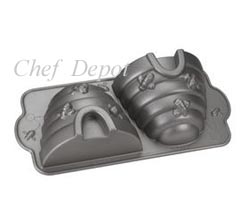
From the Templetons of Petaluma comes this delightful gift of a cake pan. We'll try it today!
Tuesday, December 9, 2008
"The way bees on a drowsy day..."
Spotted in Science Musings:
(with thanks to a friend for finding it)
More at link
(with thanks to a friend for finding it)
The phrase is from a poem titled "The Kiss," in which the poet recounts a very special osculation, during which "her lips on mine traced a design to show the way bees on a drowsy day..." Some kiss. Some poem.
Why did the phrase stick in my mind? Well, for one thing, the words are individually gorgeous. Suck is an Old English word, with an ancient Latin root. Each breath we take, each drop of mother's milk, is sucked from the world.
Fuchsia found its name more recently; it commemorates the 17th-century German botanist Leonhard Fuchs. In moving from botanist to plant, the word softened, became redolent with fragrance, got juicier. Along our lane in Ireland fuchsia runs wildly rampant.
And honey. There is probably no English word that evokes more succulent imagery: golden, pure, sweet. Honeycombs spilling their luscious liquid. Oozy sensuality.
Add "bees" and "drowsy" and you have a mini-dictionary of delight.
But it is not just the words. It is what they do together. Shakespeare tried it, too: "Where the bee sucks, there suck I." Ulick O'Connor wraps his kiss with every sense, and sucks deeply at the very essence of life.
More at link
Wednesday, November 5, 2008
It's just a box of rain. I don't know who put it there
Halloween weekend brought the first rain of the season to our Garden. It started early in the afternoon with the preschool trick-or-treaters trundling quickly along in advance of the first drops, and then held a steady presence through the night as preschoolers graduated to elementary school super-heroes and Bratz princesses and then onto the night's hulking teenage zombie ghouls and their teasing vampire girlfriends and then finally down to the last call of the young unmasked men—the ones in the neighborhood edging closest to actually being scary—disdaining costume but confidently thrusting out their bulging pillowcases of swag to the husband answering the door while I cower back in the living room looking for a good old-fashioned Universal monster flick or two to entertain.
Saturday, the weekend storm broke in Samhain's full fury: leaden grey skies dumped a ceaseless torrent on all of us and a vengeful autumn wind tore through Lanham's streets and fields. In the grove of young trees behind our condo row, denuded branches whipped and flailed at the sky, futilely clawing after stripped leaves flying away into the gutters and rooftops six houses over.
Sunday brought a break in rain and wind and even a weak sun returned with a hint of the summer that was now officially over. We went straight out to the garden to check the hives.
Where we found the ground littered with the dead and dying.
There must have been hundreds of bees there. Some clearly already still; others crawling over the rest in a slow, doomed trek. Here and there, though, a spark of furious energy as two bees tumbled and rolled in locked combat. Bee and wasp? Guard and robber? Worker and expelled drone? We surely couldn't tell.
Truth be told, we held onto the hope that this bleak horror was the pitiless matriarchal banning of the Boys of Summer. But to have hundreds of drones? From that, we moved down the list of plausible explanations to a wild hive looking for shelter in the storm. We knew of at least one such hive in a tree on a hiking trail. Could the rain have broken apart that colony and the refugee bees followed the scent of pampered suburban honey back to our hives? If so, their would-be invasion was repelled with full Amazonian fury. "Sing, O goddess, the anger of Melissa…"
But it couldn't be Colony Collapse Disorder. Certainly not. Unlike that mystery, we had the full evidence of mortality in heaps. Then the husband noted that the pattern of corpses was fullest in front of Blue Hive.
Later, we inspected. And poor old Blue Hive of my inexpert queening and the crazy comb and the inability to keep up with Grey Hive's meticulous energy and achievement: Blue Hive was ailing. The honey super seemed well stocked with capped frames, but there was a disquieting lack of populace about the place. The upper deep showed brood: but in the spotty 'every other cell' pattern of a queen in her decline. And no pollen that I could see. But the full shock was the lower deep. I pulled at a frame and was nearly thrown back by its lack of propolis resistance and the weightlessness of drawn comb unoccupied by egg, larvae, brood or nurse bee. The entire lower deep was a closed-up shop front with cardboard over the windows and a foreclosure sign on the front door.
In shock, we opened Grey Hive. Busy, industrious and thriving. Tokyo on a Saturday night. Lower and upper deep frames bulging with the next generation and their food stores.
We closed both hives and went off to seek advice.
Beekeeping for Dummies
According to them, there are six major bee diseases. These are:
We convince ourselves we see signs of all six...
Marin Bee Buzz e-mail
Danny, friend of Jane, a neighbor – fellow beekeeper in the County
(We decide that Danny has diagnosed us with Varroa mites, which are treated with powdered sugar. However, they are also visible to the eye and this is one of the few diseases we can strike from the list of probable causes. Still, I do carry cinnamon to the Garden. Weakened as it is, Blue Hive has also been targeted by ants hungry for the sugar stores. A line of cinnamon around the hive base is laid out as a defensive moat.)
Simon Bodington – Ex-patriot from Fair Albion and fellow beekeeper in the County:
Member Forum of Beesource:
Endlessly circular arguments between those who favor medical treatments and those who are committed to an fully organic approach for mite treatment. Swerving into tangential arguments over McCain and Obama.
Doug of Beekind, Sebastopol – the man who sold me the bees:
(Do I have a queen? I haven't seen one. On subsequent hive inspections, I've seen larvae—still white and healthy enough—but uncapped and untended by the dwindling population. The husband and I have debated about dumping a frame of healthy nurse bees of Grey Hive into Blue Hive. Nurse Bees haven't yet imprinted the location of their home and won't have a scent to displease guards. They'll be accepted into the ailing hive and pressed into service tending its sick and raising its young. But the husband will only accept this if we can determine that Blue Hive is disease-free. If it isn't, we'll be sentencing the emigrant bees of Grey Hive to oblivion.)
And "Ah," I thought. "Hawaii. We'll call her Liliuokalani."
But if I can't use the honey of a treated hive, can the bees?
And where does a Winter Queen find her drones?
Doug's advice turns pitilessly Malthusian by phonecall's end.
"You have a weak hive. Making an effort to save that genetic code…is it worth it?
All the advice offered conflicts and loops and turns back on itself as it gives rise to hopes only to underscore the inevitable. The main point is made: I should have treated for diseases in the early autumn. Instead of traipsing around England and Ireland as if the western world economy and my prodigal hive weren't both crumbling. And what of those first few days when I bungled my first queen's coronation? The way we piled the two honey supers on top of them: forcing them to keep up with the high-performing Grey Hive next door? Despairing, shaming guilt, never far from my door even in the best of days, slouches in and sprawls on the couch and takes over the television remote and has me fetch it a beer from the fridge.
And because treatment edges us away from organic methods, it keeps running through my mind that these exceptional creatures have thrived and prospered for millennia without human intervention. I wonder if I haven't overreacted? If this is a bad year for the hive that will be followed by many good years to come? Yet, with each hopeful hive inspection (and none of the many and varied medical advice followed), I know that Blue Hive is slowly, but surely, declining in strength and population.
We inspect again this weekend. If we see any new brood, we'll continue to hope. If not, we'll have to make our final decision.
Til the next thrilling chapter...
Saturday, the weekend storm broke in Samhain's full fury: leaden grey skies dumped a ceaseless torrent on all of us and a vengeful autumn wind tore through Lanham's streets and fields. In the grove of young trees behind our condo row, denuded branches whipped and flailed at the sky, futilely clawing after stripped leaves flying away into the gutters and rooftops six houses over.
Sunday brought a break in rain and wind and even a weak sun returned with a hint of the summer that was now officially over. We went straight out to the garden to check the hives.
Where we found the ground littered with the dead and dying.
There must have been hundreds of bees there. Some clearly already still; others crawling over the rest in a slow, doomed trek. Here and there, though, a spark of furious energy as two bees tumbled and rolled in locked combat. Bee and wasp? Guard and robber? Worker and expelled drone? We surely couldn't tell.
Truth be told, we held onto the hope that this bleak horror was the pitiless matriarchal banning of the Boys of Summer. But to have hundreds of drones? From that, we moved down the list of plausible explanations to a wild hive looking for shelter in the storm. We knew of at least one such hive in a tree on a hiking trail. Could the rain have broken apart that colony and the refugee bees followed the scent of pampered suburban honey back to our hives? If so, their would-be invasion was repelled with full Amazonian fury. "Sing, O goddess, the anger of Melissa…"
But it couldn't be Colony Collapse Disorder. Certainly not. Unlike that mystery, we had the full evidence of mortality in heaps. Then the husband noted that the pattern of corpses was fullest in front of Blue Hive.
Later, we inspected. And poor old Blue Hive of my inexpert queening and the crazy comb and the inability to keep up with Grey Hive's meticulous energy and achievement: Blue Hive was ailing. The honey super seemed well stocked with capped frames, but there was a disquieting lack of populace about the place. The upper deep showed brood: but in the spotty 'every other cell' pattern of a queen in her decline. And no pollen that I could see. But the full shock was the lower deep. I pulled at a frame and was nearly thrown back by its lack of propolis resistance and the weightlessness of drawn comb unoccupied by egg, larvae, brood or nurse bee. The entire lower deep was a closed-up shop front with cardboard over the windows and a foreclosure sign on the front door.
In shock, we opened Grey Hive. Busy, industrious and thriving. Tokyo on a Saturday night. Lower and upper deep frames bulging with the next generation and their food stores.
We closed both hives and went off to seek advice.
Beekeeping for Dummies
According to them, there are six major bee diseases. These are:
* American Foulbrood – pearly white larvae change to brown and die after capping. Cappings sink inward and appear perforated with little holes
* European Foulbrood – twisted larvae, light tan or brown in color, capped cells seem perforated
* Nosema – bees appear weak, shivery and crawl around in front of hive, spotting in and around the hive
* Chalkbrood – early Spring disease with infected larvae turning chalky white and hard in appearance
* Sacbrood – viral disease similar to the common cold
* Stonebrood – rare but recoverable
We convince ourselves we see signs of all six...
Marin Bee Buzz e-mail
It's normal to find dead drones in the fall, how many I don't know. Drones do not contribute to the needs of a wintering hive and are kicked out as winter approaches. The Queen will produce new drones in the spring to be available for mating over the summer months. Also some of the summer foragers will be dying off as the winter bees are emerging. I believe it is more normal for the older foragers to die off in the field rather than at the hive.
If you are worried about a heavy mite population, you may have to do some treatment. The most significant sign of mite stress shows up as deformed wing virus. Look to see if some of the newly emerging bees have small, deformed wings. If so, you will need to treat aggressively. I use formic acid in the fall and treat with Apistan only as a last resort.
You may need to consider some treatments for your bee hives for mites and diseases.
For Mites you can use:
1. Apistan Strips, active ingredient: Tau-fluvalinate 10.25%.
2. Mite-Away II, also treats for tracheal mites, active ingredient: Formic Acid, a "naturally appearing substance".
3. Apiguard, "a natural and nontoxic" treatment, active ingredient: Thymol gel.
Danny, friend of Jane, a neighbor – fellow beekeeper in the County
You need to install a drone frame and then treat for mites with this recipe:
1 cup of powdered sugar
½ cup of cinnamon
¼ cup of nutmeg
When the queen lays eggs on the drone frame, take it out and freeze it. Then cut off the caps and check for mites.
(We decide that Danny has diagnosed us with Varroa mites, which are treated with powdered sugar. However, they are also visible to the eye and this is one of the few diseases we can strike from the list of probable causes. Still, I do carry cinnamon to the Garden. Weakened as it is, Blue Hive has also been targeted by ants hungry for the sugar stores. A line of cinnamon around the hive base is laid out as a defensive moat.)
Simon Bodington – Ex-patriot from Fair Albion and fellow beekeeper in the County:
You'll need to call Dadant right away and see if there's still time for a treatment. But my biggest foe this year has been the wasps. Wasps could be raiding your hive. Wasps will be killing your larvae.
Member Forum of Beesource:
Endlessly circular arguments between those who favor medical treatments and those who are committed to an fully organic approach for mite treatment. Swerving into tangential arguments over McCain and Obama.
Doug of Beekind, Sebastopol – the man who sold me the bees:
"Dead larvae is normal. A small hive is normal. But, yeah, sounds like your hive is troubled. Sounds like tracheal mites. You'll want to treat. But then…you know you won't be able to use the honey from a hive in treatment. Do you have a laying Queen? If you don't have a laying Queen, you can re-queen. But it's going to be expensive though. You'll have to get her from Hawaii…
(Do I have a queen? I haven't seen one. On subsequent hive inspections, I've seen larvae—still white and healthy enough—but uncapped and untended by the dwindling population. The husband and I have debated about dumping a frame of healthy nurse bees of Grey Hive into Blue Hive. Nurse Bees haven't yet imprinted the location of their home and won't have a scent to displease guards. They'll be accepted into the ailing hive and pressed into service tending its sick and raising its young. But the husband will only accept this if we can determine that Blue Hive is disease-free. If it isn't, we'll be sentencing the emigrant bees of Grey Hive to oblivion.)
And "Ah," I thought. "Hawaii. We'll call her Liliuokalani."
But if I can't use the honey of a treated hive, can the bees?
And where does a Winter Queen find her drones?
Doug's advice turns pitilessly Malthusian by phonecall's end.
"You have a weak hive. Making an effort to save that genetic code…is it worth it?
All the advice offered conflicts and loops and turns back on itself as it gives rise to hopes only to underscore the inevitable. The main point is made: I should have treated for diseases in the early autumn. Instead of traipsing around England and Ireland as if the western world economy and my prodigal hive weren't both crumbling. And what of those first few days when I bungled my first queen's coronation? The way we piled the two honey supers on top of them: forcing them to keep up with the high-performing Grey Hive next door? Despairing, shaming guilt, never far from my door even in the best of days, slouches in and sprawls on the couch and takes over the television remote and has me fetch it a beer from the fridge.
And because treatment edges us away from organic methods, it keeps running through my mind that these exceptional creatures have thrived and prospered for millennia without human intervention. I wonder if I haven't overreacted? If this is a bad year for the hive that will be followed by many good years to come? Yet, with each hopeful hive inspection (and none of the many and varied medical advice followed), I know that Blue Hive is slowly, but surely, declining in strength and population.
We inspect again this weekend. If we see any new brood, we'll continue to hope. If not, we'll have to make our final decision.
Til the next thrilling chapter...
Wednesday, July 30, 2008
Gimme Gimme Gimme (A Drone after Midnight)
This was originally going to be my Fourth of July chapter for the Garden Chronicles. Instead, thanks to the Fellowship of the Dirt Pile double-trilogy (that means a SIX Chapter Saga to you calculus majors); this is being written while American pundits dissect a Paris Hilton televised riposte to John McCain's attack on Obama.
Paris Hilton = Blond + Balls . Who knew? And, sure, it's Obama in '08: but You GO Paris!
And speaking of the long history of American populist fronts: from the moment I heard the name, I wanted to be a Daughter of the American Revolution.
You see, I first heard about this radical fringe organization in one of Abbie Hoffman's later books. He and the girls were working together to save a historic bridge in Connecticut. His thing was stopping some development; theirs was preserving history. So you can understand why I formed a somewhat skewed perspective on the Ladies from his account. There they were: working with none other than Chicago Seven Hoffman! On the front lines of an anti-corporate battle. With a totally bitchin' gang name! Meet up with ya on the streets of Seattle, Ms. Abigail…
Yeah, they sounded hot.
Instead, yes—I am aware of the real story here—they are the well-established organization that requires you to prove that your ancestors were hanging around in 1776 and somehow participated in the severing of the nascent nation's moorings from our mothership across the pond. And then slavishly worshipped the totems of its culture from afar for the next Two Hundred.
In other words: no other immigrants need apply. But hey! That's why we've got the Portuguese Festa Hall, Las Guitarras and Finnegan's of Marin down on Grant Street. Gotta have some Nuevo Mundo spice in that Old World melting pot.
But the point I'm trying to make here, if anyone could claim to be a Daughter of the American Revolution, it's the honeybee. Not aboriginal at all, but early immigrant to the North American continent, crossing over on the Mayflower with John Alden and Priscilla Mullins and Captain Ahab and Pocahontas on her homebound afternoon commute and all. (And then there's me sweating out my hour's drive home with the two packages of starter bees from Sebastopol. Imagine: live bees on a four-month trans-Atlantic voyage. Now that's hard core. All respect to Myles Standish and Company.)
Indeed, the honeybee's manifest destiny to find these bountiful, virgin stores of California pollen earned it the bitter nickname of "white man's fly" from the Native Americans encountering its sting in conjunction with successive waves of European settlers' progress across their lands.
Which brings us to the rich, but problematic, world of the bee as political metaphor. The colony, the queen, the workers, royal jelly, and the drones. All of it redolent with class and caste and labor of the lowly in the service of the great. The Victorians, in particular, went absolutely crackers over the concept. (Or "Oh!" as several of my friends enthuse. "Have you read A.S. Byatt's Angels and Insects?" Yes, I have. Certainly. Years ago. But Possession was better. IMO. MHO of course.)
In particular, the concept of "queen" is a point of fascination for children stopping by to visit the garden hives and for the children we met during our shift at the observation hive at the County Fair. They all ask to see the hive's Queen. Perhaps they are imagining some delicate, bee-beautiful creature with a fairy's gossamer crown. A wing-born sister to that legendarily lovely and languid monarch of the Sea Monkeys (you'd know them as "brine shrimp") who once ruled over her underwater anthropomorphic court in the back ads of the Richie Rich comics of my childhood.
When, in point of fact, what you have here is a fat, slow, non-flying insect stuffed with more semen than a San Francisco bathhouse locker room on a Saturday night in a hot summer month of that morally bankrupt Bicentennial year of 1976.
Well yeah! Baby!! Let us now talk about Sex. Let's pop an amyl-nitrite and cue up the Grace Jones and: Let's. Get. Busy. Birds do it. Bees do it. Even educated fleas do it. It's Friday night and the lights are low; lookin' out for a place to go.
There's a long, intricate history of wistful legend and hopeful lore of the King Bee in western culture. In Yemen, there's even the concept of a "Father Bee." And there are indeed male bees. They are bigger than the females and do (the technical term here is 'fuck all') little work in or around the hive. The ladies assiduously tend and feed them all spring and summer.
New drones come along, as needed, throughout the summer and I've already learned to look for the particular little brood cells that bulge out from the frames. For a bee, the drone leads a damned lazy and pampered life.
And then: he gets to mate with royalty.
According to the University of Florida Department of Entomology & Nematology, this is a "most spectacular" ritual. As it does involve "partial phallus detachment" (as you do) and death, I think we can all agree with that description. We know the start; we know the end. Masters of the scene:
La question cest voulez-vous!
And there's no luck for the celibate drone either – that smart boy who's figured out that hanging back at the tail of that suitors' comet might be the best way to avoid love's lethal embrace – sure, maybe he flies back home to the safety of his internet porn bookmarks, but the Mortality's Clock still ticks. Come September, after the last nectar flow, the ladies of the hive begin their winter downsizing and all drones are slowly, but firmly, hustled out the front door. They are now last season's boy-toys and, as no other hive will take them in and as they know ("Fuck all," remember?) little about collecting food for themselves, they're toast.
I imagine these drones of autumn meeting up with fellow exiles from other local hives. "Must be that time of the year, eh?" one jokes half-heartedly. "She's never been this mad before" another says in genuine perplexity. Then one of them suggests "Look guys. Let's just get a bouquet of flowers and a box of candy and go back and say 'I'm sorry.'" "What are we sorry for?" someone else asks. "Doesn't matter. We're just 'sorry.'" And indeed, they are.
As for Her Majesty (a pretty nice girl): consider the following. If, in the history of human affairs, many a lovely crowned head landed in the axeman's basket on the charges of adultery, the hive queen – and she can be deposed at any time when the workers decide she's not up to the task -- who enjoys the longest reign is a promiscuous, free-ranging slut.
From Science Daily:
Lick? Rub? Oh honey honey, touch me baby. The Science Daily article also makes clear that the queen may or may not be mating with the drones of her hive, which is why I can claim my small place in helping the world by providing it with strong, organically raised party boys wearing tight genes.
So: Gynocentric advocates of Free Love as well as caretakers of communal property derived from the shared labor of an empowered working class. "When in the course of hive events it becomes necessary for one swarm to dissolve the political bonds which have connected them with another…"
Can you hear the drums, Fernando?
"It's NOT a monarchy," I told the crowd watching me on April 26 as I was anchoring my rubber band tether around the marshmallow-stoppered queen cage of Grey Hive. "What we have here, as I see it, is a Radical Feminist Collective."
Til the next thrilling chapter,
Miss "They were shining there for you and me. For Liberty" Templeton
P.S. There were five ABBA [and one Beatle] songs referenced in this email. Did you spot them all?
P.P.S. Just to note: my particular breed of bees trace their ancestry back to another group of immigrants. They passed through Ellis Island alongside of Vito Corleone and family.
Paris Hilton = Blond + Balls . Who knew? And, sure, it's Obama in '08: but You GO Paris!
And speaking of the long history of American populist fronts: from the moment I heard the name, I wanted to be a Daughter of the American Revolution.
You see, I first heard about this radical fringe organization in one of Abbie Hoffman's later books. He and the girls were working together to save a historic bridge in Connecticut. His thing was stopping some development; theirs was preserving history. So you can understand why I formed a somewhat skewed perspective on the Ladies from his account. There they were: working with none other than Chicago Seven Hoffman! On the front lines of an anti-corporate battle. With a totally bitchin' gang name! Meet up with ya on the streets of Seattle, Ms. Abigail…
Yeah, they sounded hot.
Instead, yes—I am aware of the real story here—they are the well-established organization that requires you to prove that your ancestors were hanging around in 1776 and somehow participated in the severing of the nascent nation's moorings from our mothership across the pond. And then slavishly worshipped the totems of its culture from afar for the next Two Hundred.
In other words: no other immigrants need apply. But hey! That's why we've got the Portuguese Festa Hall, Las Guitarras and Finnegan's of Marin down on Grant Street. Gotta have some Nuevo Mundo spice in that Old World melting pot.
But the point I'm trying to make here, if anyone could claim to be a Daughter of the American Revolution, it's the honeybee. Not aboriginal at all, but early immigrant to the North American continent, crossing over on the Mayflower with John Alden and Priscilla Mullins and Captain Ahab and Pocahontas on her homebound afternoon commute and all. (And then there's me sweating out my hour's drive home with the two packages of starter bees from Sebastopol. Imagine: live bees on a four-month trans-Atlantic voyage. Now that's hard core. All respect to Myles Standish and Company.)
Indeed, the honeybee's manifest destiny to find these bountiful, virgin stores of California pollen earned it the bitter nickname of "white man's fly" from the Native Americans encountering its sting in conjunction with successive waves of European settlers' progress across their lands.
Which brings us to the rich, but problematic, world of the bee as political metaphor. The colony, the queen, the workers, royal jelly, and the drones. All of it redolent with class and caste and labor of the lowly in the service of the great. The Victorians, in particular, went absolutely crackers over the concept. (Or "Oh!" as several of my friends enthuse. "Have you read A.S. Byatt's Angels and Insects?" Yes, I have. Certainly. Years ago. But Possession was better. IMO. MHO of course.)
In particular, the concept of "queen" is a point of fascination for children stopping by to visit the garden hives and for the children we met during our shift at the observation hive at the County Fair. They all ask to see the hive's Queen. Perhaps they are imagining some delicate, bee-beautiful creature with a fairy's gossamer crown. A wing-born sister to that legendarily lovely and languid monarch of the Sea Monkeys (you'd know them as "brine shrimp") who once ruled over her underwater anthropomorphic court in the back ads of the Richie Rich comics of my childhood.
When, in point of fact, what you have here is a fat, slow, non-flying insect stuffed with more semen than a San Francisco bathhouse locker room on a Saturday night in a hot summer month of that morally bankrupt Bicentennial year of 1976.
Well yeah! Baby!! Let us now talk about Sex. Let's pop an amyl-nitrite and cue up the Grace Jones and: Let's. Get. Busy. Birds do it. Bees do it. Even educated fleas do it. It's Friday night and the lights are low; lookin' out for a place to go.
There's a long, intricate history of wistful legend and hopeful lore of the King Bee in western culture. In Yemen, there's even the concept of a "Father Bee." And there are indeed male bees. They are bigger than the females and do (the technical term here is 'fuck all') little work in or around the hive. The ladies assiduously tend and feed them all spring and summer.
New drones come along, as needed, throughout the summer and I've already learned to look for the particular little brood cells that bulge out from the frames. For a bee, the drone leads a damned lazy and pampered life.
And then: he gets to mate with royalty.
According to the University of Florida Department of Entomology & Nematology, this is a "most spectacular" ritual. As it does involve "partial phallus detachment" (as you do) and death, I think we can all agree with that description. We know the start; we know the end. Masters of the scene:
Copulation occurs on the wing, within a drone congregation site 15-30 m above ground (Gary 1963). An aggregation of drones “lazily” fly within their congregation site awaiting the arrival of a queen, and once she appears a fast-paced chase commences where copulation is attempted (Winston 1987). The term “drone comets” visually describe the continual consolidation and disassembly of this following drone swarm (Winston 1987). Koeniger et al. (1979), utilizing a tethered queen, report that the drone clasps the queen in a dorso-ventral position and everts his endophallus directly into the queen’s sting chamber. The drone then becomes “paralysed” and falls backwards (Koeniger et al. 1979). Woyke and Ruttner (1958) state the eversion of the endophallus occurs from haemostatic pressure caused by abdominal muscles. Ejaculation occurs into the bulb portion of the drone’s endophallus prior to full eversion, and semen is discharged through a small opening in the bulb into the queen’s vagina during copulation (Woyke and Ruttner 1958). Winston (1987) figuratively asserts that the drones “explode” their semen into the queen’s copulatory orifice, and consequently toward her oviduct. Through subsequent pressure the bow of the bulb and chitinized plates, the “mating sign,” detaches from the endophallus of the drone and remains inside the queen (Woyke and Ruttner 1958). Winston (1987) concludes this may help thwart the flow of sperm from the queen’s vagina after copulation, and that it does not function as a “mating plug” used to discourage multiple matings. After the pair separate the endophallus is still fully everted with its associated strong pressure, and with loss of the “mating plug” the endophallus may burst at the tip (Woyke & Ruttner 1958). At the end of copulation, the drone falls to the ground and dies either in minutes or hours (Woyke and Ruttner 1958, Winston 1987).
La question cest voulez-vous!
And there's no luck for the celibate drone either – that smart boy who's figured out that hanging back at the tail of that suitors' comet might be the best way to avoid love's lethal embrace – sure, maybe he flies back home to the safety of his internet porn bookmarks, but the Mortality's Clock still ticks. Come September, after the last nectar flow, the ladies of the hive begin their winter downsizing and all drones are slowly, but firmly, hustled out the front door. They are now last season's boy-toys and, as no other hive will take them in and as they know ("Fuck all," remember?) little about collecting food for themselves, they're toast.
I imagine these drones of autumn meeting up with fellow exiles from other local hives. "Must be that time of the year, eh?" one jokes half-heartedly. "She's never been this mad before" another says in genuine perplexity. Then one of them suggests "Look guys. Let's just get a bouquet of flowers and a box of candy and go back and say 'I'm sorry.'" "What are we sorry for?" someone else asks. "Doesn't matter. We're just 'sorry.'" And indeed, they are.
As for Her Majesty (a pretty nice girl): consider the following. If, in the history of human affairs, many a lovely crowned head landed in the axeman's basket on the charges of adultery, the hive queen – and she can be deposed at any time when the workers decide she's not up to the task -- who enjoys the longest reign is a promiscuous, free-ranging slut.
From Science Daily:
To determine the effect mating has on honey bee queens, the scientists artificially inseminated queens. It's difficult to determine the number of times a queen mates under natural conditions. Some queens were inseminated with the semen from one drone, others with the semen from 10 drones. The scientists then put the queens in hives and observed them.
They found that worker bees paid more attention to the multiply inseminated queens. Worker bees demonstrate what is known as a "retinue response" to their queen; they lick her and rub their antennae on her. The retinue response to the multiply inseminated queens was more pronounced.
"This tells us the workers can tell how many drones the queen has mated with," said Grozinger.
Lick? Rub? Oh honey honey, touch me baby. The Science Daily article also makes clear that the queen may or may not be mating with the drones of her hive, which is why I can claim my small place in helping the world by providing it with strong, organically raised party boys wearing tight genes.
So: Gynocentric advocates of Free Love as well as caretakers of communal property derived from the shared labor of an empowered working class. "When in the course of hive events it becomes necessary for one swarm to dissolve the political bonds which have connected them with another…"
Can you hear the drums, Fernando?
"It's NOT a monarchy," I told the crowd watching me on April 26 as I was anchoring my rubber band tether around the marshmallow-stoppered queen cage of Grey Hive. "What we have here, as I see it, is a Radical Feminist Collective."
Til the next thrilling chapter,
Miss "They were shining there for you and me. For Liberty" Templeton
P.S. There were five ABBA [and one Beatle] songs referenced in this email. Did you spot them all?
P.P.S. Just to note: my particular breed of bees trace their ancestry back to another group of immigrants. They passed through Ellis Island alongside of Vito Corleone and family.
Subscribe to:
Posts (Atom)


